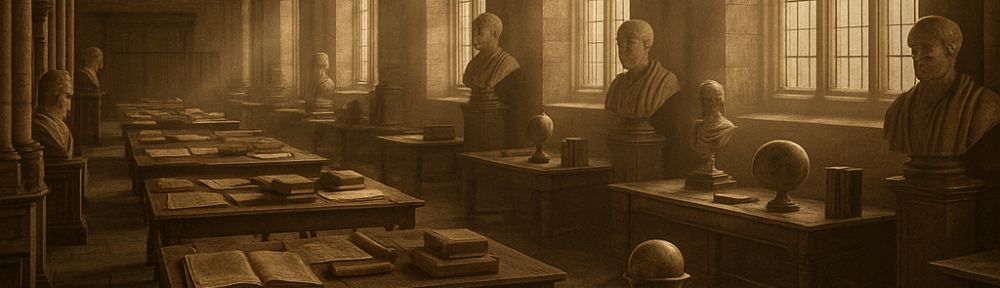
Classical Languages, an austere pillar of venerable tradition, invites the scholar to traverse the labyrinthine corridors of Latin and Greek—tongues that echo the vanished empires and shadowed sanctuaries of human antiquity. Here, the pursuit of these ancient languages is more than rote exercise; it is an initiation into literature and thought whose very origins predate the comfortable daylight of modern understanding.
This department serves not only those who are drawn, with a species of dread fascination, into the deeper mysteries of advanced Latin and Greek, but extends its spectral influence throughout the university. Mastery—or even the most elementary acquaintance—with these classical tongues is deemed essential for students of English Literature, Modern Languages, Philosophy, and Ancient History. The sciences, too, bend to this tradition; all acolytes of medicine and seekers after empirical certainty are directed, by institutional decree, to undertake at least a semester’s passage through the gauntlet of Introductory Latin and Greek. Such study forms a foundation upon which the scaffolding of rational inquiry is precariously raised, their roots entwined with sources far older and less placid than reason supposes.
Classes Offered
Introductory Greek
In the dim vestibule of linguistic tradition, this course stands as an initiation into the austere intricacies of Classical Greek. Under vigilant guidance, students will confront the rigor of grammar, the labyrinthine folds of syntax, and the labyrinth of unfamiliar vocabulary—each component a foundation stone upon which greater knowledge is perilously constructed. Cloaked within the apparent lucidity of rules and forms lurks an unfathomed heritage, echoing epochs whose thoughts and fears are whispered through the language itself.
While the rituals of pronunciation and inflection are dutifully observed, the primary ordeal resides in exercises of written translation. Thus is offered not only the mechanical ability to transmute symbols into meaning, but also the rarefied chance to glimpse, hesitantly, the ancient literary corpus—texts whose elegance often belies a strange and latent profundity. The scholar who embarks upon this study treads paths well worn by generations, yet ever shadowed by the vast and silent unknowns inherent to all true inquiry.
Introductory Latin
Amidst the dust-laden tomes of remote antiquity, the Latin tongue persists—not as a vestige wholly shorn of meaning, but as a living conduit to the foundations of reason and inquiry. Those who undertake this course will discover that Latin resides both within the cold marble of pediments and the subtle intricacies of modern discourse. Its study is essential for any seeker aspiring to penetrate the labyrinthine origins of English grammar, to discern the spectral echoes shaping contemporary vocabulary, and, above all, to pursue a discipline of mind befitting the sober, lettered individual.
The design of Introductory Latin is both modest and profound: students will be afforded a disciplined initiation in the vocabulary and structure of this formidable language. With the guidance of a dictionary and the application of intellect, participants shall be equipped to render passages from the realm of the ancients into modern tongue—an exercise that is at once scholarly pursuit and confrontation with the enduring shadow of the past.
Comparative Greek and Latin Grammar
Within the muted corridors of linguistic inquiry, this course offers a rigorous introduction to the ancient disciplines of comparative philology and the intricate science of phonetics. Students are beckoned to trace the spectral correspondences binding Greek and Latin, discernible only through patient study and a willingness to confront the primordial echoes of human utterance.
A rudimentary acquaintance with Sanskrit, itself rooted in linguistic antiquity, is strongly advised for all who contemplate enrolment. Those bereft of prior engagement with Sanskrit are gently counseled to undertake a preliminary examination of the supplemental volume Beginning Sanskrit, lest the hidden architectures of etymology elude their grasp. Here, the veil thins between civilizations, and the foundations of known grammars await sober investigation.