Across the somber halls and shadowed alcoves of Miskatonic University, the Department of Occult Studies stands as a solitary beacon for those who would press beyond the perimeters of sanctioned knowledge. Here, under the relentless scrutiny of tradition and taboo, the term occult—drawn from the Latin occultus, meaning that which is secreted from the eye—has found peculiar purpose. Within this unique program, faculty and acolytes alike engage in the unsparing excavation of the world’s most enigmatic doctrines, secret liturgies, and arcane rites, knowing full well that with the unveiling of each mystery, another shadow is cast.
Rather than shrinking from what is veiled, our curriculum deliberately courts the margins of reason, drawing upon disciplines both canonical and heretical. Epistemological inquiry is interwoven with comparative folklore, anthropological fieldwork, cryptic scripts, and the psychological architectures of belief. Our department’s scholarship, both solitary and collaborative, has ever labored under the weight of ancestral knowledge, always aware that to glimpse the hidden is not without consequence.
The Occult Studies program thus appeals to the rare scholar—one prepared not for simple solutions, but for the abyssal uncertainties that inevitably arise when pursuing the forbidden threads entwined in human history. Caution, curiosity, and a healthy respect for the ineffable are all requisites for those who choose to seek what was never meant to be easily found. Applicants are advised: the pursuit of knowledge in these chambers may yield answers both wondrous and unnerving, and to inquire too deeply is sometimes to imperil the inquirer.
Distinguished Alumni 2
Occult Studies
Alchemy
Occult Topics
Astrology
Class Memorabilia
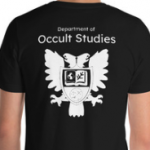
Dept of Occult Studies t-shirt